Retinol for beginners: how to start without wrecking your skin
Retinol is one of the best-studied ingredients for fine lines, uneven texture and breakouts. It's also the one people most often overdo. Here's how to start slowly and get the results.
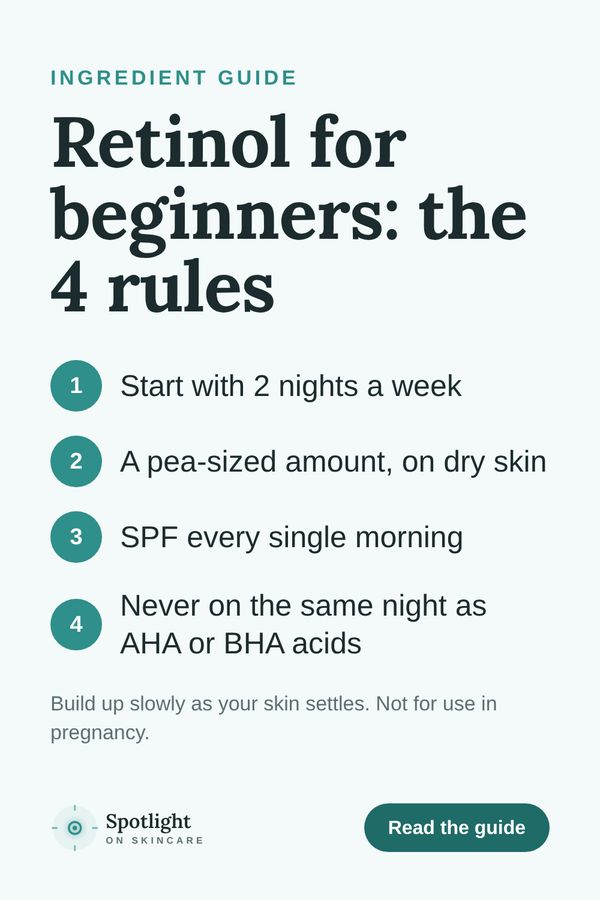
- Start with 2 nights a week.
- A pea-sized amount for the whole face, on dry skin.
- SPF every single morning.
- Never on the same night as AHA or BHA acids.
What retinol actually does
Retinol is a form of vitamin A. In the skin it's converted into retinoic acid, which speeds up cell turnover and supports collagen. Over months, that shows up as smoother texture, softer fine lines, more even tone and fewer clogged pores. It is a slow ingredient: most people notice a difference after 8 to 12 weeks, not days.
Which retinoid, and what strength?
| Type | Strength | Who it suits |
|---|---|---|
| Retinyl esters / granactive retinoid | Gentlest | Sensitive skin, nervous first-timers |
| Retinol | 0.2% to start, then 0.5%, then 1% | Most people |
| Retinal (retinaldehyde) | Stronger, faster | Once you're used to retinol |
| Tretinoin, adapalene | Prescription in the UK | Through your GP or a dermatologist |
Start at the bottom. A low strength used consistently beats a high strength you have to stop because your skin is sore.
A low-cost, low-strength first retinol in a soothing base.
How: two nights a week to begin.
A gentler alternative if retinol irritates you.
How: two to three nights a week.
How to use it, step by step
- Cleanse and pat your skin completely dry. Retinol on damp skin can sting more.
- Pea-sized amount for the whole face. Dot it on forehead, cheeks and chin, then spread. Keep it away from the corners of your eyes, nostrils and lips.
- Moisturiser on top.
- SPF 30+ the next morning, every morning, even in winter.
Weeks 1 to 2: two nights a week. Weeks 3 to 4: three nights. After that: every other night, and then most nights if your skin is calm.
The "sandwich" method for sensitive skin
Apply a thin layer of moisturiser, then the retinol, then more moisturiser on top. It cushions the retinol and reduces dryness, and is a good way to start if your skin is easily irritated.
Purging vs irritation
Some people get a few extra spots in the first 4 to 6 weeks, in the places they normally break out. This "purging" usually settles. Stinging, burning, peeling and redness are not purging: they mean you're using too much or too often.
Signs you're overdoing it
- Stinging when you put on moisturiser.
- Flaky, peeling patches that won't settle.
- Skin that looks red and feels tight.
- Makeup suddenly sits badly.
If that's you, stop for a few days, use only a gentle cleanser, a plain moisturiser and SPF, then restart at once or twice a week.
What not to use with retinol
- Exfoliating acids (glycolic, lactic, salicylic): use them on different nights.
- Benzoyl peroxide: use it in the morning, retinol at night.
- Scrubs, peels and waxing on treated areas.
Not sure what your skin needs?
Six quick questions, and you get a morning and evening routine for your skin type, goals and budget.
Take the free 2-minute assessmentThis guide is general information, not medical advice. If you have a skin condition, are pregnant or breastfeeding, or something isn't improving, speak to a pharmacist, your GP or a dermatologist.