How much SPF should you use on your face?
SPF is the single best anti-ageing step there is, and most of us use about half of what's needed. Here's how much to use, what the labels mean, and how to make it a habit.
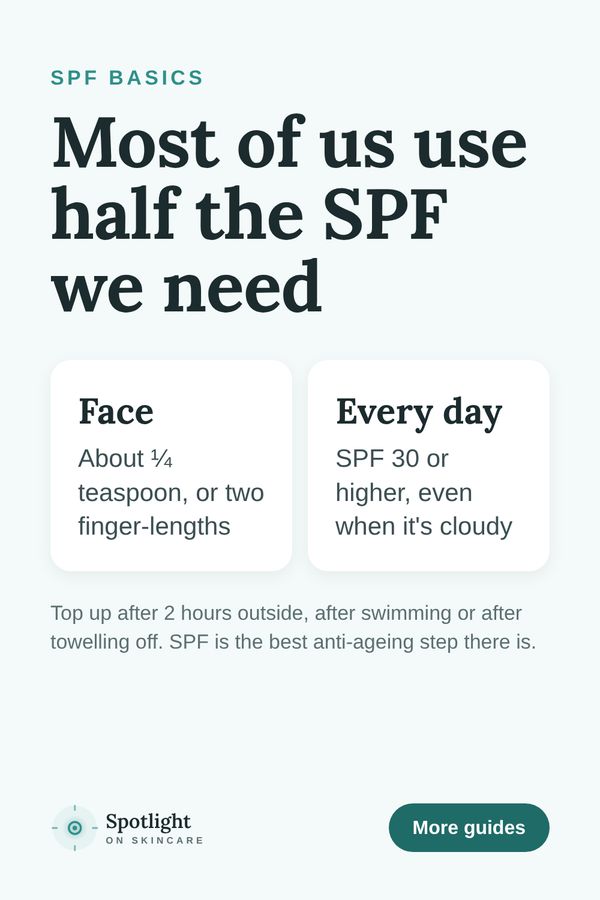
- About ¼ of a teaspoon for face and neck, or two finger-lengths.
- SPF 30 or higher, with a good UVA rating.
- Every day, even when it's cloudy.
- Top up after 2 hours outside, swimming or towelling off.
Why the amount matters
The SPF number on the bottle is tested using a generous amount of sunscreen. Use half that, as most people do, and you get far less protection than the label says. The easiest fix is to measure: two lines of sunscreen along your index and middle fingers covers the face and neck.
Reading a UK sunscreen label
| On the label | What it means |
|---|---|
| SPF 30, SPF 50 | Protection from UVB, the rays that cause burning. 30 is the everyday minimum. |
| UVA star rating (up to 5 stars) | How much UVA (ageing) protection you get compared with the UVB. Look for 4 or 5 stars. |
| UVA in a circle | Meets the EU standard for UVA protection. |
| "Broad spectrum" | Protects against both UVA and UVB. |
SPF myths to ignore
- "My makeup has SPF in it." You'd need a lot of foundation to get the stated protection. Use a proper SPF underneath.
- "I don't need it in winter." UVA, the ageing rays, is there all year and goes through windows.
- "Darker skin doesn't need SPF." Darker skin burns less easily but still gets sun damage and pigmentation.
How to make it a habit
Find a texture you like using: a light fluid or gel for oily skin, a creamier one for dry skin, a tinted one if you skip foundation. Keep it next to your toothbrush. Apply it as the last step of your morning routine.
A very light fluid that suits most skin types and sits well under makeup.
How: last step every morning.
A budget mineral option for sensitive skin.
How: last step every morning; mineral formulas can leave a slight cast on deeper skin tones.
Not sure what your skin needs?
Six quick questions, and you get a morning and evening routine for your skin type, goals and budget.
Take the free 2-minute assessmentThis guide is general information, not medical advice. If you have a skin condition, are pregnant or breastfeeding, or something isn't improving, speak to a pharmacist, your GP or a dermatologist.